Saltcreek
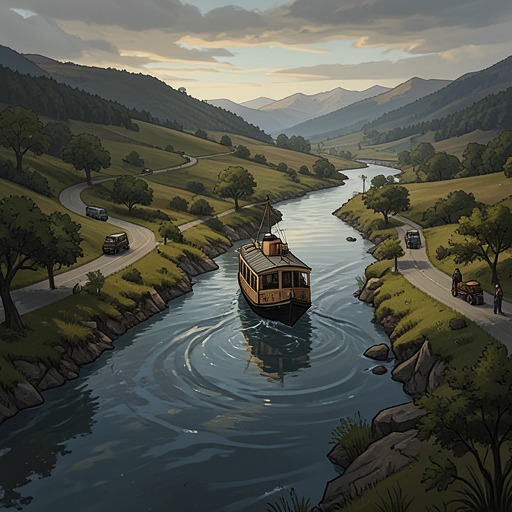
Towards ZeroSaltcreek is the old fishing village on the hill beside the river Tern, a settled, conservative community that stands in sharp contrast to the resort across the water. Its position among the river, steep ground, ferry landing, and nearby cliffs gives it a practical role in the novel’s geography: Saltcreek is both a destination and a point of passage, where journeys between the village, Easterhead Bay, and Gull’s Point become evidence in the murder investigation.
Setting and Contrast
Saltcreek is described as straggling and picturesque, with an old-fashioned character and a deeply dismissive attitude toward Easterhead Bay and its summer visitors. Across the river, Easterhead Bay is newly developed around a broad sandy bathing beach, modern bungalows, and a large hotel on the headland facing the sea. The contrast is not simply between two types of scenery. The village represents an established local community; the resort brings a seasonal population and newer buildings into the same landscape. The river keeps the places distinct while making their proximity unavoidable.
The surrounding terrain is steep and exposed. Lady Tressilian’s house, Gull’s Point, stands on a rocky plateau above the river, with sheer cliffs descending to the water on two sides. Its gardens and tennis court lie beside the house, while its garage is farther along the road, on the other side of it. This placement gives the house a clear relation to the village and river crossings, but also makes access dependent on routes over land or water rather than on an uninterrupted level approach.
Routes Across the River
The ferry is a rowing boat run by brothers Will and George Barnes. It connects the Saltcreek side with Easterhead Bay and gives the river crossing a human, locally observed character: the brothers know everyone in Saltcreek by sight and recognize most people who come over from the resort. Their familiarity turns an ordinary transport service into a source of information for the investigation.
George reports that Mr. Strange crossed from Gull’s Point at 10:30 the previous night and did not return with the ferry. The last ferry had left the Easterhead side at 1:30, and Mr. Strange was not aboard it. The timetable and the brothers’ recognition of passengers therefore help narrow the account of a journey: the crossing is not an anonymous movement through empty space, but one that leaves witnesses and limits what routes were available at particular times.
Other journeys place Saltcreek within a wider network of approach. Thomas Royde arrives by train at Saltington, where Mary Aldin waits for him on the platform. The account distinguishes this railway arrival from the subsequent local geography: the ferry and roads connect people to the village and Gull’s Point, while Saltington is the point where Royde’s journey by train meets Mary’s local arrangements.
The Village and the Investigation
The ferry’s practical importance becomes especially clear when the investigation tests whether someone could have crossed the river and reached the house. Superintendent Battle distinguishes the possibility that a person came from the opposite bank by swimming from the separate requirement that someone inside Gull’s Point must have prepared a rope for that person. The river crossing may explain how an outsider arrived; it does not, by itself, account for access to the house. Saltcreek’s geography thus helps frame a question of coordination between movement outside and assistance within.
MacWhirter also crosses by ferry to the Saltcreek side, returning for a second visit to Stark Head. He walks slowly up the hill, passes the Balmoral Court Hotel, and then goes by a large house set on the point of a cliff. He recognizes the name Gull’s Point on its painted door and understands that it is where the old lady was murdered. He has already heard about the case from his chambermaid and seen it given prominence in the newspapers, attention that annoys him because he prefers world affairs and has little interest in crime. The route makes the murder’s publicity part of the local landscape without making MacWhirter himself an eager follower of it.
Narrative Significance
Saltcreek’s importance lies in the way ordinary geography acquires evidential force. The village’s position across the river from Easterhead Bay establishes two distinct shores; the ferry records crossings; the road and hill connect the landing to the prominent houses and hotel; and the cliffs around Gull’s Point make the river a possible route as well as a boundary. Each feature affects how characters travel and how their movements can be checked.
The setting also places local knowledge beside wider attention. The Barnes brothers’ recognition of people is immediate and personal, while the newspapers and hotel talk carry news of the murder beyond the village. MacWhirter’s reluctance to follow crime stories sets him apart from that circulating attention, even as his return to Stark Head brings him past the house at its center. Saltcreek is therefore both a community with its own established view of the resort and a junction where visitors, witnesses, and investigators encounter the same divided landscape.